Lawn and Pest
What Moves Into Oklahoma City Homes in September
Fantastic Lawn • September 2026 • Oklahoma City Metro • 7 min read
Short Answer: As Oklahoma nights start cooling in September, the insects that spent all summer living in your lawn and landscape begin looking for somewhere warmer and drier. In the OKC metro that means crickets, spiders, roaches, boxelder bugs, and mice pressing in against your foundation and finding the gaps around doors, weep holes, utility penetrations, and garage seals. The response that actually works is a perimeter treatment paired with sealing the specific openings they use, done before the first real cold front rather than after you spot them inside. Once they are indoors, control gets slower, more invasive, and more expensive.

If you are reading this because you found three crickets in your garage this week and you are wondering whether that means something, it does. It is the opening act. Most homeowners we talk to in the metro notice the first few, decide it is nothing, and then call us three weeks later when the trickle has turned into a steady stream.
The encouraging part is that this is one of the most predictable events on the pest calendar. It happens at roughly the same time every year, driven by the same trigger, through the same handful of openings. Predictable problems are the ones you can get ahead of.
Why September Flips the Switch
Through an Oklahoma summer, the ground outside is a perfectly good place to live. There is moisture in the soil, cover in the turf and mulch beds, and plenty to eat. Nothing about your house is especially appealing by comparison.
That changes when nighttime temperatures start dropping into the 50s. Insects do not generate their own body heat, so as the ground cools, their activity slows and their survival odds fall. What they are doing when they push toward your foundation is not invading. It is looking for a microclimate that still feels like summer, and the warm, dry envelope of your house is the best one on the property.
Your foundation is also where the warm air leaking out of your house meets the cool air outside. Picture standing outside a shop door on a cold day and feeling the warmth spill out. Insects along your foundation are reading that same signal, and they follow it to its source.
The Five We Get Called About Most
Across the properties we service in the metro, the September calls cluster around a short list.
Crickets are usually first and loudest. They come in through garages and door sweeps, and a single one behind a wall can keep a household awake for a week. Spiders follow the crickets, because crickets are food, which is why a spider problem indoors is very often a cricket problem you did not notice.
Roaches, particularly the larger outdoor species people around here call water bugs, come up through drains, weep holes, and gaps around plumbing penetrations. Boxelder bugs and their relatives gather in large numbers on warm south and west facing walls in the afternoon sun, then work their way into siding gaps and window frames. And mice, which need a gap roughly the width of a pencil, start testing the base of your house in earnest once the nights turn.
Different animals, one shared motive. That is why the fix is structural rather than species by species.
How They Actually Get In
When we walk a house in September, we are looking at a fairly short list of places, and it is nearly always the same list.
The garage door seal is the single biggest offender in this market. Most are worn, and the corners where the seal meets the frame almost always have a gap you can see daylight through. Door sweeps on exterior doors are second. Weep holes in brick, which exist for good reasons and should not be sealed shut, are a genuine highway unless they are screened. Then there are the penetrations: where the AC line set, the dryer vent, the gas line, and the hose bibs pass through the wall, there is usually a gap around the pipe that was never properly sealed.
Add to that the landscape conditions that stage insects right up against the house in the first place. Mulch piled against the foundation, shrubs touching the siding, firewood stacked by the wall, and irrigation that keeps a damp band around the perimeter all concentrate the population exactly where you least want it.
Why Treating the Outside Beats Treating the Inside
This is the part we most want homeowners to understand, because it changes what you should expect from a pest service.
A can of spray applied to a bug you can see kills that bug. It does nothing about the several hundred still outside working the same seam. Treating indoors is a reaction to something that has already gone wrong, and it puts product in the spaces where your family and pets actually live.
A perimeter treatment works differently. It puts a treated band around the outside of the structure, in the zone insects have to cross to reach an opening. They meet it before they get in. The result is that most of the problem never becomes visible to you, which is a strange thing to sell, because when it works you see nothing at all.
Timing is what makes it work. A perimeter application in place before the first significant cold front catches the migration as it starts. The same application in November is chasing a population that is already behind your walls.
What You Can Do Without Calling Anyone
Some of this is genuinely a Saturday afternoon of work and it makes a real difference.
Replace the garage door seal if you can see light under it at the corners. Fit or replace door sweeps. Seal around the pipe and cable penetrations with an appropriate sealant or copper mesh where the gap is large. Pull mulch back a few inches from the foundation so there is a dry break. Trim shrubs so nothing touches the siding, and move firewood away from the house. Fix the sprinkler head that soaks the wall every morning.
Do those things and you have removed both the invitation and several of the doors. We would rather tell you that than pretend the answer is always a product.
One more that costs nothing: change what your exterior lights do at night. Bright white bulbs by the front and back doors pull in flying insects from a surprising distance, and everything that eats those insects follows them to the wall. Warm toned or yellow bulbs are far less attractive to them, and moving a light away from the door itself helps as much as changing the bulb. It is the cheapest pest control decision available, and almost nobody makes it deliberately.
The Lawn and the House Are One Problem
Because we handle both sides, we see the connection constantly, and it is worth naming.
The insects arriving at your foundation in September came from somewhere, and mostly that somewhere is the turf and beds around the house. A lawn with heavy thatch, chronic moisture, and an untreated insect population is a reservoir feeding the perimeter. Treating the house while ignoring the yard means you are intercepting a supply line rather than reducing it.
When we sit down with a new customer, this is often the moment the lawn program and the pest program stop looking like two separate purchases. They are two views of the same property.
What to Do Next
Walk your foundation this week. Start at the garage, crouch down, and look for daylight. Check every place a pipe or wire enters the wall. Note where mulch or shrubs are touching the house. That walk takes fifteen minutes and tells you most of what you need to know.
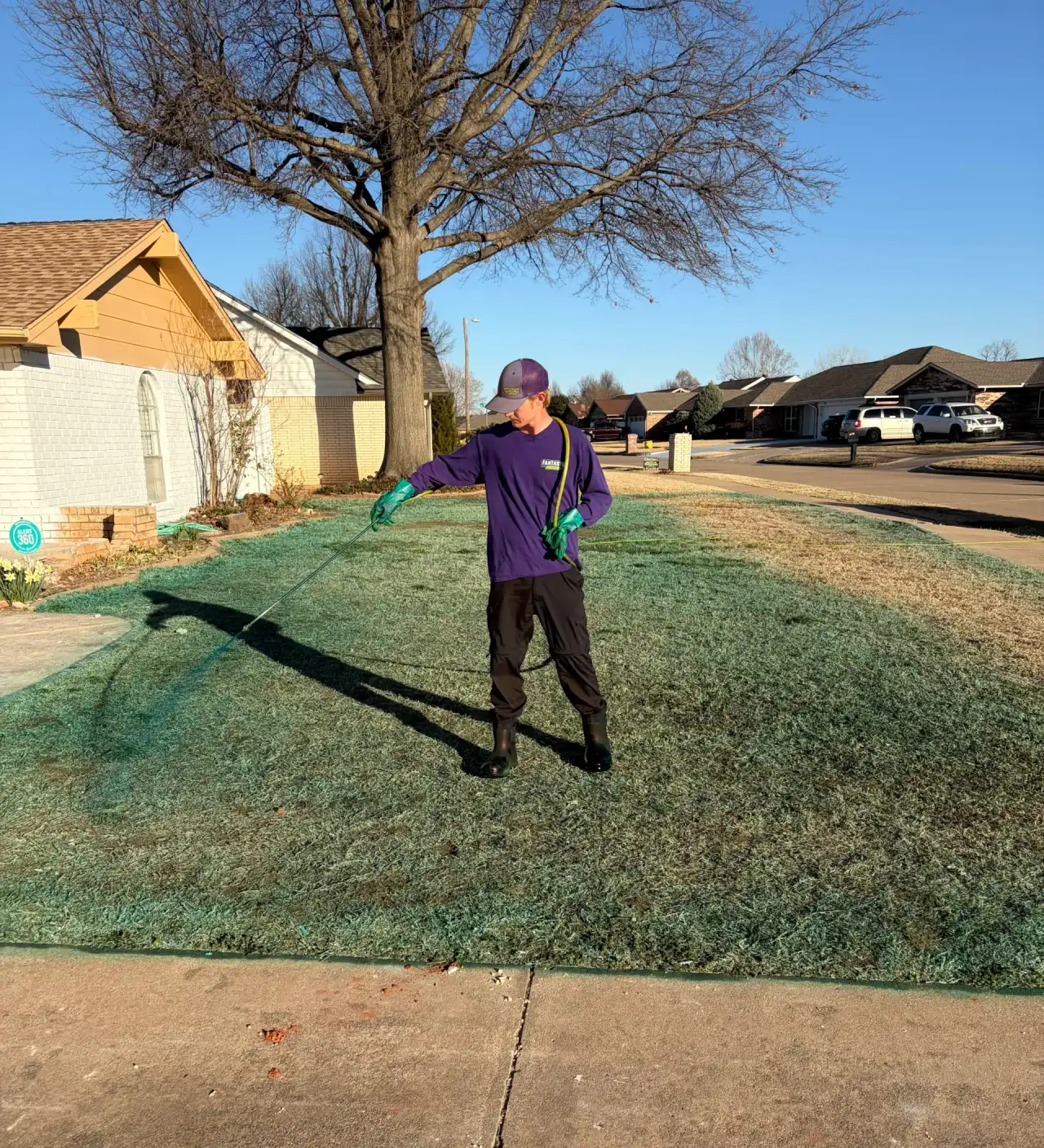
If you would rather have someone handle the perimeter treatment, the timing, and the entry points for you, that is exactly what we do. Fantastic Lawn covers lawn care and pest control across the Oklahoma City metro, including Edmond, Norman, Moore, Yukon, Mustang, Midwest City, and Piedmont. Call us at 405-766-7979 or visit fantasticlawn.com.
Here is what to expect from the visit. We will walk the outside of the house with you rather than heading straight for a sprayer, point out the specific gaps we find, and tell you which ones are worth sealing yourself. Then we will treat the perimeter before the weather turns. If the real problem is a worn garage seal, we would rather you fix the seal than buy a treatment every quarter to compensate for it.