Bermuda Grass Care in June: Mowing Height, Watering, and Fertilizer for Edmond Lawns
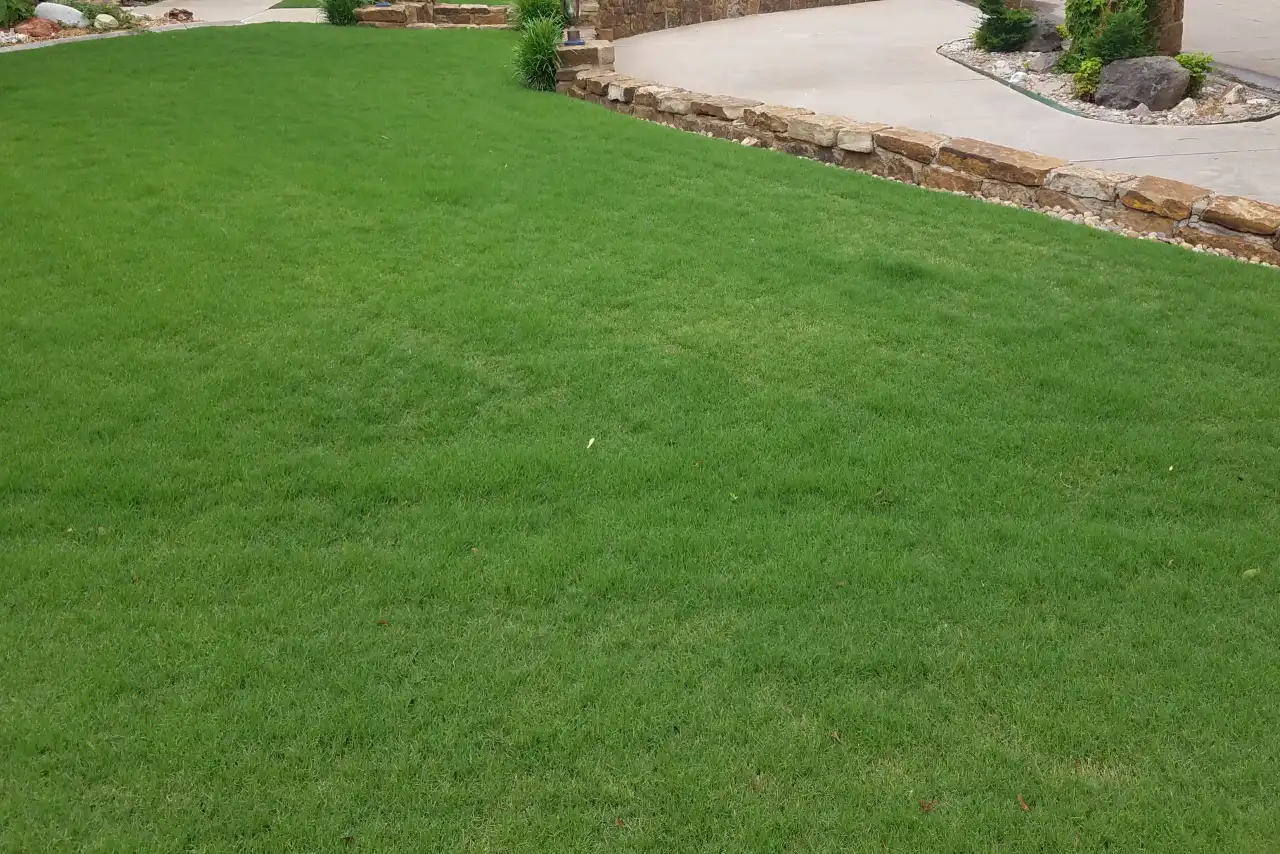
Fantastic Lawn • June 2026 • Edmond & Oklahoma City, OK
Short Answer: Bermuda grass in Edmond and the OKC metro needs three specific settings dialed in by mid June to survive summer cleanly: mowing height at 2.5 to 3 inches with mowing every 5 to 7 days, deep infrequent watering of about an inch per week applied in two early-morning cycles, and a slow-release summer fertilizer at moderate rates with added potassium. The lawns that look great in August are the ones whose owners get these three settings right by mid June. Lawns that miss the setup show stress by mid July no matter what else they do.
If you have a Bermuda lawn in Edmond, North OKC, Yukon, or anywhere in the metro and you want it looking great by the 4th of July, this post is for you. We get the same call every year. Homeowner watered hard in May, fertilized in early June, and the lawn looked great. Then by late June it started looking tired. By July it was thin in spots and yellow in others.
The cause is almost always one of three setup issues that should have been dialed in early in the month. We want to walk you through each one and exactly what to do.
Mowing Height: 2.5 to 3 Inches
The single biggest mistake we see on OKC area Bermuda lawns is mowing too short. People hear "Bermuda likes a short cut" and take their lawn down to one and a half inches because that is the height golf courses use. The catch is that golf courses also have specialty Bermuda varieties, daily greens mowing, full irrigation, and dedicated greenskeepers. Your residential lawn is not a golf course.
For common Bermuda and most improved hybrids on residential lawns, the right summer height is 2.5 to 3 inches. The taller cut produces several benefits at once. Shaded soil retains moisture better. Deeper roots develop because the lawn has more leaf area for photosynthesis. Weed seeds in the soil do not get enough light to germinate. Heat stress is reduced because the canopy protects the crowns of the plants.
Mow every 5 to 7 days through summer growth. Never remove more than one third of the blade in a single cut. If you let the lawn get long and then take it back to height in one mow, you scalp the crowns and stress the lawn at the worst possible time.
Sharpen the mower blade if you have not yet this season. A dull blade tears the leaf tip and gives the lawn a hazy white look two days after mowing, plus opens the door for disease.
Watering Depth: One Inch Per Week in Two Cycles
The second setup change is watering. Most OKC metro irrigation systems run daily 15-minute cycles, which is fine in April and wrong in June. Daily light watering trains roots into the top inch and a half of soil, where they fail when the heat sets in.
The right summer setup is two cycles per week, applied in the early morning between 4 and 8 a.m., delivering about half an inch each. Total is one inch per week including rainfall. For rotary heads (about a third of an inch per hour), that is 75 to 90 minutes per zone twice a week. For spray heads (about three quarters of an inch per hour), 35 to 40 minutes twice a week.
For clay-heavy soils common across our area, use cycle and soak. Run the zone for 25 minutes, soak 45 minutes, run another 25, soak 45, run a final 25. Same total runtime, much better infiltration, dramatically less runoff.
Validate the schedule with the screwdriver test. A long screwdriver should slide into the lawn 5 to 6 inches the morning after watering. If it stops at 2 or 3 inches, the watering is not penetrating deep enough.
Fertilizer: Slow Release With Potassium
The third setup decision is what to feed the lawn for summer. The mistake we see most often is heavy nitrogen applied in late spring or early summer. The lawn pushes a flush of soft growth that has no root depth behind it. Two weeks later when temperatures hit 95, the soft growth cannot support itself and the lawn looks tired.
The right product for June feeding is a slow-release summer fertilizer with moderate nitrogen and added potassium. The slow release means the lawn gets fed steadily over 8 to 10 weeks rather than getting one big surge. The potassium supports heat and drought tolerance, which is exactly what Bermuda needs going into July.
Apply at the lower end of the rate range printed on the bag. June is not the month for heavy applications. Water in within 24 hours of application.
Skip weed and feed combinations in June. Most contain herbicides that can damage warm-season grass under heat stress, and they are usually formulated for cool-season grass anyway.
Common Mistakes That Undo the Setup
Panic-watering when the lawn looks tired. Daily short cycles undo the deep-watering training and create new problems faster than they solve old ones. Stay on the twice-weekly schedule even when the lawn looks a little stressed.
Mowing low to "get it tidy" before the holiday. Scalping the lawn before a hot stretch can do more damage than the cosmetic boost is worth. If you must lower the height, do it gradually over multiple mowings.
Applying more nitrogen because the lawn is yellow. If the yellowing is iron chlorosis (common on alkaline OKC soils), nitrogen makes it worse. Diagnose before fertilizing again.
Forgetting to adjust the mower as the lawn fills in. Bermuda grows fast in June. The right height changes the time between mowings, not the height itself.
What This Setup Does
Lawns that hit all three of these correctly by mid June consistently produce the following results: dark uniform color through July and into August, fewer brown spots when temperatures peak, less weed pressure because the canopy shades the soil, less disease pressure because the canopy dries faster, and lower water bills because the schedule is efficient.
The contrast between properly set up Bermuda and neglected Bermuda is dramatic by late July across the metro. The lawns that look great are not magic. They are correctly set up. The lawns that look stressed are not unlucky. They are usually missing one or more of the three settings.
The Edmond and OKC Bermuda Calendar at a Glance
For quick reference, here is the typical Bermuda calendar for our metro. February to early March: pre-emergent application. Late March to April: green-up begins, first balanced fertilizer. May: heavy growth, weekly mowing starts, increase watering depth. June: heat builds, set up summer schedule (this post). July to August: peak heat, maintain deep infrequent watering and consistent mowing height. Late August: pre-fall feeding, plan aeration. September: aeration window, fall fertilizer. October to November: winter pre-emergent, final feeding. December to January: dormancy. The June setup is the inflection point. Get it right and the rest of summer follows. Get it wrong and August requires rescue work.
Frequently Asked Questions
What if I have already been watering daily through May?
Switch to twice-weekly deep watering now. The lawn will look slightly stressed for the first week as roots adjust, then recover stronger than before.
Can I do the mowing and watering myself and just hire out the fertilizer?
Absolutely. The cultural practices are the most impactful and the most homeowner-doable. Many of our customers run that split.
How do I know if my lawn needs aeration this summer?
Screwdriver test. If a long screwdriver pushed in after watering stops at 2 or 3 inches, your soil is compacted. June is a viable aeration window for Bermuda in our area.
Should I add iron supplement?
If your lawn shows pale yellow color with green veins, iron deficiency may be the cause. A chelated iron application brings color back within 1 to 2 weeks. Pair with longer-term soil pH correction if pH is high.
What If You Want Help With Some of This
Most of our customers in Edmond and North OKC fall into one of three patterns. Some homeowners want full-service: we handle mowing, fertilizing, weed control, insect treatment, irrigation tune-ups, and everything else. Some want partial service: we handle the technical work (fertility, weed control, insect treatment, pre-emergent timing) and the homeowner handles mowing and watering. Some want diagnostic and consulting only: we audit the lawn quarterly and tell the homeowner what to do, leaving execution to them. Whichever pattern fits your time and budget, we can structure the service to match. Our goal is a great-looking lawn at fair pricing, not selling services you do not need.
What to Do Next
If you want help running through this setup on your specific lawn, we are glad to walk the property and tell you straight what needs attention. We can also handle any of the work you would rather not do yourself.
Call us at 405-766-7979 or visit fantasticlawn.com to schedule. We serve Edmond, North Oklahoma City, Yukon, Norman, Moore, and surrounding OKC metro communities.