Pre-Fall Aeration Planning in OKC: Why July Decisions Decide Whether Your September Service Pays Off
Fantastic Lawn • July 2026 • Edmond & Oklahoma City, OK
Short Answer: September is the right window to core aerate Bermuda lawns across the OKC metro. By the time September arrives, however, the candidacy decision has already been made. A July walk of the property tells us whether your lawn will respond to aeration (compaction, thatch over half an inch, thin density, irrigation puddling), whether it needs related services like topdressing or overseed with cool-season grass for winter color, and whether the schedule has room. Lawns booked in July get the early September slot when soil moisture is right. Lawns booked in September often get pushed to mid October when the recovery window is shorter and the return on the service is smaller.
Core aeration is one of those services that gets sold confidently every fall and delivers wildly different results depending on whether the lawn was a real candidate. We have aerated lawns in September that thickened up visibly within four weeks and were noticeably denser the following spring. We have also aerated lawns that looked exactly the same in October as they did in August. The difference is not the aeration equipment or the technician. It is whether the lawn needed the service in the first place.
July is when we figure that out. A property walk in mid summer reveals what a property walk in September cannot. The lawn is under full stress, watering schedules are at their peak, growth is at its highest, and any structural problems below the soil surface are forced to show themselves. By September, cooler weather has masked some of the problems we want to see. Here is what we look at in July to make the call.
What Aeration Actually Does on Bermuda
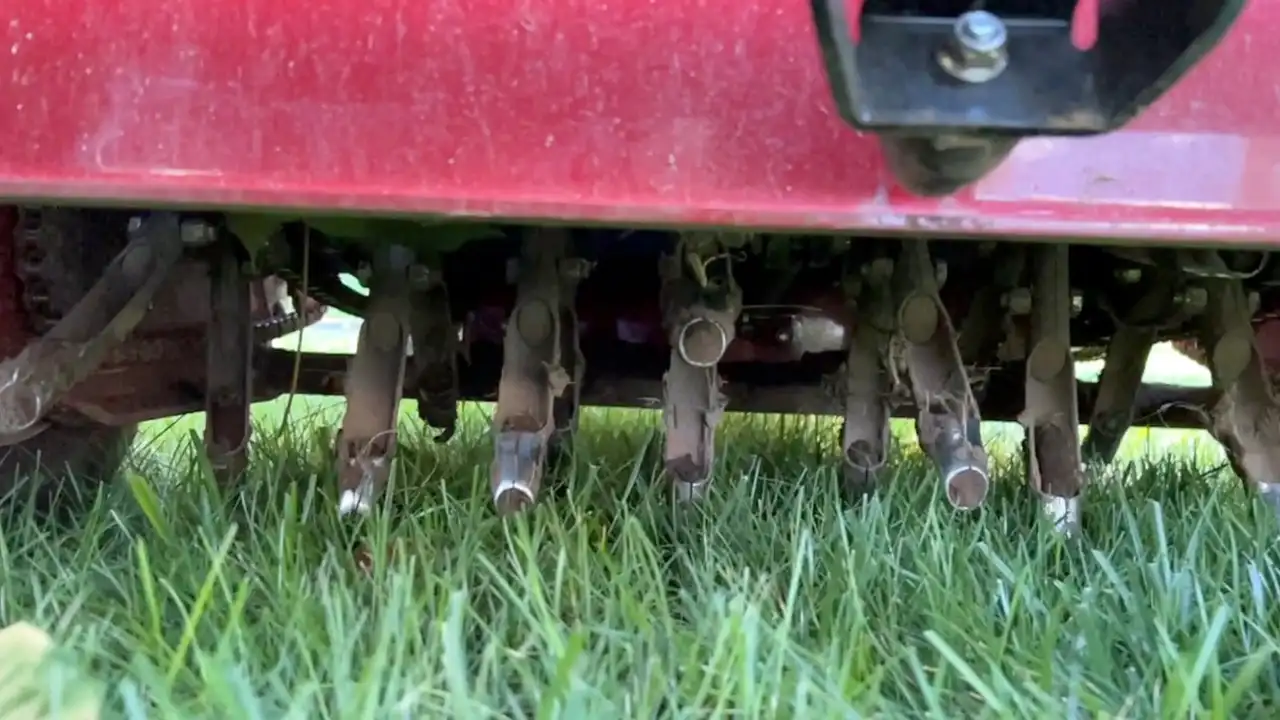
Before getting into who is a candidate, it helps to be precise about what aeration does. A core aerator pulls plugs of soil and turf out of the lawn, typically half-inch cores three to four inches deep, spaced four to six inches apart. The cores get left on the surface to break down. The holes do four things.
First, they relieve compaction in the top three inches of soil. Compacted soil restricts root growth and reduces water infiltration. On red clay across the OKC metro, compaction is the rule, not the exception. Second, the holes increase oxygen exchange at the root zone, which improves microbial activity and nutrient cycling. Third, they create channels for water to penetrate to depth instead of running off the surface. Fourth, on Bermuda specifically, they cut runners and encourage lateral spreading, which thickens density.
What aeration does not do: solve a watering problem, kill weeds, fix a fertility imbalance, or rescue a lawn that is dying from grubs or disease. If you aerate without diagnosing the actual problem, you end up with the same problem and a lawn full of holes.
The July Candidacy Checklist
Here is the checklist we run on every July property walk to decide whether aeration belongs on the September schedule.
The screwdriver test. The morning after a watering cycle, push a long screwdriver (at least 8 inches) into the lawn at several spots. If it slides in 5 to 6 inches with light pressure, compaction is acceptable and aeration is not urgent. If it stops at 2 or 3 inches, the soil is compacted and aeration is justified. We test in five spots per quarter acre: the front yard, the most-walked path to the door, a back yard high-traffic zone, the area under the swing set or trampoline, and an undisturbed corner.
The thatch measurement. Cut a four-inch by four-inch plug with a sharp knife, pull it out, and measure the brown spongy layer between the green leaf material and the soil. Less than half an inch is healthy. Half to three quarters of an inch is borderline. More than three quarters of an inch indicates thatch buildup that aeration alone will not solve (verticutting or scalping may be needed instead). Bermuda thatches faster than fescue, especially on heavily fertilized lawns, and we see thatch problems regularly on properties that have been on commercial programs for several years.
Water infiltration. Pour a gallon of water over a one-square-foot area in a flat zone. Time how long it takes to absorb. Under five minutes is good infiltration. Five to fifteen minutes is moderate. Over fifteen minutes indicates compaction or hydrophobic soil. We do this test at three locations on the property.
Density and bare spots. A healthy Bermuda lawn has 80 to 95 percent ground coverage. Visible soil between blades when the canopy is parted indicates thinning. Bare spots larger than three inches indicate areas where aeration plus overseed or sod plugs may be needed.
Root depth. When you pulled the four-inch thatch plug, look at the root system. Healthy summer Bermuda has roots extending 3 to 6 inches deep with white tips. Roots that stop at one inch with brown lower portions indicate compaction or watering problems.
Irrigation puddling. Watch a watering cycle. If water pools or sheets across the surface within the first ten minutes of zone runtime, infiltration is poor and aeration will help. Look especially in clay-heavy zones and in spots where wheel traffic from the mower has run repeatedly.
If three or more of these six checks indicate problems, the lawn is a strong candidate. If only one or two show problems, the answer is conditional and depends on the homeowner's goals and budget. If none show problems, save the money and put it toward something that will move the needle.
Why September Is the Right Window for Bermuda
Bermuda recovers from aeration fastest when soil temperatures are still above 70 degrees and growth is still active. In the OKC metro, that window is mid August through mid October. The sweet spot is the first three weeks of September. Soil temperatures are still warm, daytime highs have eased into the upper 80s, nighttime temperatures are dropping enough to relieve heat stress, and the lawn has six to eight weeks of growing weather to heal the cores and respond to the service.
Aerating too early (July, August) stresses an already-stressed lawn and risks weed germination through the open cores. Aerating too late (after October 15) leaves the lawn with open wounds heading into dormancy, which produces a thinner spring than it would otherwise have. We hold our aeration schedule to roughly September 1 through October 10. That window is narrow, and the calendar fills quickly.
The Booking Math
Here is the practical scheduling reality across the metro. A two-truck operation like ours can aerate about 12 to 16 lawns per day. The high-demand window is six weeks long. That works out to roughly 350 to 500 aerations per crew per season. Demand is consistently 30 to 50 percent higher than that capacity.
Lawns booked between July 1 and August 15 get the early September slot when soil moisture is highest and recovery is fastest. Lawns booked between August 15 and September 15 get the mid to late September slot, which still works well. Lawns booked after September 15 get whatever is left, which is usually late September or October, with the trade-off that recovery is slower and the homeowner is paying the same rate for a smaller return.
This is not a sales pressure point. It is the schedule reality. The same calendar pressure exists for every legitimate aeration provider in the OKC area. If you call in September, you may get on the schedule. You may also get told there is no opening before October 15. The lawn is the same lawn either way, but the service is less effective at the later date.
What to Pair With Aeration
Aeration alone is useful. Aeration paired with the right companion services is much more effective. The July audit decides which companions belong on the work order.
Topdressing. If thatch is over half an inch or the lawn surface is uneven, a quarter-inch topdressing of compost or sand-and-compost blend brushed into the aeration holes accelerates thatch breakdown and smooths the surface. Add cost is meaningful but the payoff in soil health is real over two to three seasons.
Soil amendment. If a July soil test shows pH above 8.0 or below 6.5, calcium or sulfur amendments worked into the aeration holes get to the root zone faster than surface broadcast can. Same goes for gypsum on heavy clay where calcium displacement opens soil structure.
Overseed with cool-season grass for winter color. Some metro homeowners overseed Bermuda with perennial ryegrass for winter green color. October overseed timing pairs naturally with mid October aeration. We do not recommend this for every property because the spring transition back to Bermuda has trade-offs, but on certain high-visibility properties it is the right call.
Pre-emergent for winter weeds. A late September pre-emergent for poa annua and henbit needs to go down after aeration heals (typically two to three weeks). The July audit determines whether the timing will work and what product is appropriate.
Who Should Skip Aeration This Year
Not every lawn benefits. A few situations where we tell homeowners to wait or to spend the money elsewhere.
Lawns less than a year old. Newly sodded or newly seeded lawns need time for root systems to establish before being disturbed. Skip aeration until the lawn has been in for at least one full growing season.
Lawns currently fighting disease or insect damage. Aerating a lawn with active armyworm damage or a brown patch flare just adds more stress. Treat the active problem, get the lawn back to baseline, then aerate the following season.
Lawns where the real problem is irrigation coverage. Aerating will not fix a zone with three missing heads. Spend the money on the irrigation system first.
Lawns scheduled for renovation. If a property is going to be sodded or resodded in the spring, fall aeration is throwing money at a lawn that will be replaced.
What Service Costs and What You Get
Aeration pricing in the OKC metro for an average residential lawn runs roughly $125 to $275 depending on lot size and access. A topdressing add-on adds $200 to $600. A combined aeration plus overseed with rye for winter color runs $350 to $700 on most properties.
What you get for that money: a measurable increase in water infiltration, a measurable reduction in compaction, a typically 15 to 30 percent improvement in turf density by the following May on a candidate lawn, and a longer functional life for the existing turf. The numbers are smaller on lawns that were not real candidates, which is why the July audit matters.
Frequently Asked Questions
Can I aerate myself with a rental machine?
You can. Rental core aerators run roughly $90 to $130 for four hours at the big-box rental counters. The catch is that the rental machines are usually drum-style aerators with shorter tines and lighter weight, and they pull shallower cores than the commercial walk-behinds we run. On compacted clay you may need to make multiple passes to get equivalent benefit. Doable, but plan for it physically.
Should I water before or after aeration?
Both. Water the lawn the day before so the cores pull cleanly and the soil releases without resistance. Water again the day after so the open holes do not dry out. After that, return to normal watering schedule.
Do I need to do anything about the cores left on the lawn?
Leave them. They break down over two to three weeks and return organic matter and microbial activity to the soil. Some homeowners drag the lawn with a leaf rake to break them up faster, which is fine but not required.
How often should I aerate?
On a residential Bermuda lawn with moderate traffic, every other year is sufficient. On heavily used lawns with children, dogs, and frequent mower passes, annually is appropriate. On low-use lawns with sandy or amended soils, every third year may be enough.
What If You Want Help With the Audit and the Service
The two most common patterns on our route. The first group asks us to handle the July audit and the September aeration as a package. We walk the property in July, give a candidacy read, recommend any companions (topdressing, overseed, soil amendment), confirm the booking, and execute the work. The second group asks for the July audit only, wants to understand what their lawn needs, and may handle the aeration themselves with a rental or skip the year entirely. Both are fair. The point of the July walk is to make the decision deliberate rather than reactive.
What to Do Next
If you have not already planned fall aeration for your OKC metro lawn, July is the month to decide. We are glad to walk the property, run the audit checklist, and tell you whether September service is worth booking on your specific lawn.
Call us at 405-343-7205 or visit fantasticlawn.com to schedule. We serve Edmond, North Oklahoma City, Yukon, Norman, Moore, and surrounding OKC metro communities.