Mosquito Control
Where Mosquitoes Spend the Day, and Why Treatment Targets Your Property Edges
Fantastic Lawn • October 2026 • Norman & the OKC Metro • 8 min read
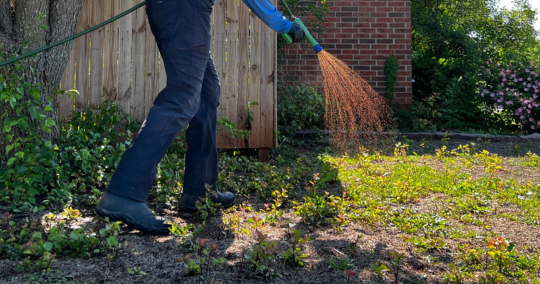
Short Answer: Mosquitoes spend most of the day resting rather than flying, and they rest in cool, shaded, humid places with still air. That means the undersides of leaves, dense shrub beds, ivy and ground cover, fence lines, tree lines, and the space under a deck. A barrier treatment puts product on those surfaces so mosquitoes contact it while resting, which is why a technician works the edges of a property and the vegetation rather than walking the open lawn. It holds roughly two to four weeks before sun, rain, and new growth break it down.
If you have watched a mosquito treatment being applied and wondered why the technician spent twenty minutes along your back fence and never touched the middle of the yard, there is a specific reason, and it is the single most useful thing to understand about how this service works.
Mosquitoes are not distributed evenly across a property and they are not flying most of the time. Knowing where they actually are explains the treatment, the timing, and why some yards are much harder to protect than others.
Most of the Time, They Are Resting
A mosquito spends the large majority of its life sitting still. Flying is expensive and exposes them to heat, wind, and dehydration, so they fly when they are seeking a blood meal or laying eggs and they rest the rest of the time.
Resting is not casual. They are avoiding three things that will kill them, which are heat, direct sun, and moving air. A mosquito in open sunlight on a warm afternoon dries out quickly, so they seek the opposite conditions and they are consistent about it.
What they want is shade, high humidity, still air, and a surface to cling to underneath something. Put those four together and you have described the underside of a leaf in the middle of a dense shrub, which is exactly where they are.
That consistency is what makes treatment possible. If mosquitoes rested randomly there would be nothing to target. Because they concentrate in predictable places, those places can be treated.
Mapping a Typical Yard
Walk your own property and you can find these spots yourself. On most Norman area lots they fall in the same places.
Fence lines come first, particularly wood privacy fences with vegetation growing along them. The fence blocks air movement, the vegetation holds humidity, and the shaded side stays cool through the afternoon. This is usually the single most productive resting area on a residential property.
Dense shrub beds are second. Anything planted tightly enough that the interior stays dark and still qualifies, and mature foundation plantings are ideal. Ivy and ground cover work the same way at ground level, holding a humid still layer underneath the foliage.
Tree lines and the shaded canopy underneath are third, especially on lots backing up to a greenbelt, a creek, or an undeveloped parcel. Low hanging branches on the shaded side of a mature tree hold mosquitoes through the day.
Then the structural spots. Under decks, which combine shade, still air, and often damp soil. Behind and around the air conditioning unit, where condensate keeps things humid. Along the foundation on the north side of the house. In tall grass or unmaintained edges where the mower does not reach.
What none of that list includes is the open lawn, and that is the point. A mosquito in the middle of a sunny yard at two in the afternoon is a mosquito in trouble.
What a Barrier Treatment Actually Is
A barrier treatment applies a residual product to those resting surfaces so that mosquitoes contact it while sheltering. It works on contact with the treated surface rather than by filling the air.
Application equipment matters more here than people expect. Getting product onto the undersides of foliage deep inside a shrub bed requires a mist blower that can push material into and through vegetation. A standard garden sprayer wets the tops of leaves, which is the surface mosquitoes are least likely to be sitting on.
So a proper application looks like a technician working methodically through the vegetated edges of a property, directing product up and into foliage rather than down at the ground, and spending very little time in open areas. Under decks, along fence lines, into shrub interiors, and up into low canopy.
The word barrier is slightly misleading, since it is not a wall and it is not repelling anything at the property line. It is a treated zone covering the places mosquitoes want to be, which reduces the resident population rather than blocking entry.
Larvicide Covers What Cannot Be Drained
Barrier treatment addresses adults. Water you cannot remove needs a different tool, and a thorough service includes it.
Larvicide treats standing water so mosquito larvae do not survive to become adults. It is the right answer for water that has to stay, including drainage areas that hold after rain, low spots that will not grade out, rain barrels, ornamental features without circulation, and catch basins.
The products commonly used for residential water are biological, targeting mosquito larvae specifically while leaving most other aquatic life alone. That makes them appropriate around water features and areas where wildlife visits.
Where water can simply be removed, removing it is always better than treating it. Larvicide is for the water that has to stay, not a substitute for dumping a plant saucer.
Why It Wears Off
A treatment generally holds for two to four weeks, and understanding why sets expectations properly.
Sunlight breaks down residual product over time, which is one reason shaded areas hold a treatment longer than exposed ones. Rain washes it off, and a heavy storm shortly after application will shorten the window meaningfully. Irrigation does the same thing, which is why running sprinklers on shrub beds right after a treatment works against you.
New growth is the factor people miss. Product sits on the surfaces it landed on, and a leaf that unfurls after treatment is untreated. During active growing season, vegetation is constantly producing fresh untreated surface, which is part of why the effect fades on a schedule rather than all at once.
This is why mosquito control is delivered as a recurring service rather than a one time fix. It is a window of protection, and a company promising season long results from a single application is overselling.
What It Will Not Do
Being straight about the limits is more useful than overselling, and there are four worth naming.
It will not eliminate every mosquito. Expect a substantial reduction in what you notice, not a mosquito free yard. Anyone promising elimination is describing something that does not happen outdoors.
It will not stop mosquitoes flying in from elsewhere. Dusk biting Culex species travel farther than the container breeders, so a neighbor's neglected pool or an adjacent drainage easement continues contributing. Treatment reduces your resident population, which on most properties is the majority of the problem but not all of it.
It will not substitute for removing standing water. Treatment reduces adults. Source reduction stops the next generation. The properties that get the best results do both, and skipping the free half to pay for the other half is backwards.
And it will not survive a heavy mow and blow immediately afterward. Cutting back treated vegetation or blowing debris through treated beds removes treated surface. Scheduling your yard work before a treatment rather than after protects what you paid for.
Pollinators and Timing
Worth addressing because people ask and it is a fair concern.
Responsible application means avoiding blooming plants, since products used for mosquitoes are not selective and flowers are where pollinators are. A technician should be treating structural vegetation, foliage undersides, and shaded edges rather than blanketing a flowering bed.
Timing helps too. Early morning or evening application, when pollinator activity is lowest, reduces exposure further. If you keep a pollinator garden, point it out before the first treatment so it can be excluded from the application area.
This is a reasonable thing to ask any company about. How do you handle blooming plants, and what time of day do you apply. A clear answer is a good sign.
What to Do Next
Walk your property and find your own resting habitat. Look for the shaded, still, humid places, which usually means the fence line, the shrub interiors, under the deck, and the tree line at the back. That tells you where your pressure is coming from and where a treatment needs to focus.
Make the easy improvements while you are out there. Thinning dense shrubs improves air movement, keeping grass trimmed along edges removes low resting cover, and pruning low branches on the shaded side of trees helps. Those changes make a yard less hospitable year round.
If you are scheduling a treatment, do your mowing and trimming beforehand rather than after, and hold off on irrigating treated beds for a day. Both protect the application you just paid for.
Here is what to expect. A noticeable drop within a day or two, holding two to four weeks depending on sun and rain, and focused on the edges of your property rather than the middle. If someone treats your open lawn and skips your fence line, they have it backwards.
If you would rather have someone map the resting habitat and treat it properly, we are here for that. Call Fantastic Lawn at 405-343-7205 or visit fantasticlawn.com for a free quote. We serve Norman, Oklahoma City, Edmond and the surrounding communities.